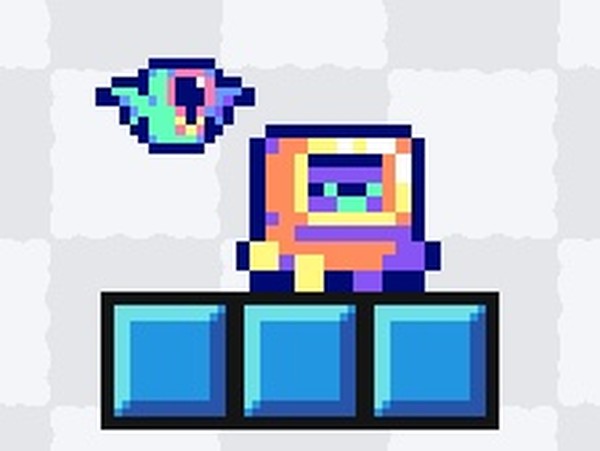
WASDbox Cooperative Puzzle Adventure understands that cooperation means more than shared goals. By giving one player the creature and the other the bat, it makes each person responsible for a different part of every solution. The pixel art stays clear, the hazards escalate at a reasonable pace, and time tracking adds replay value. The main limitation is that it strictly requires two players, so solo play is not an option. For pairs who enjoy logic games and talking through puzzles, it offers a compact and well-defined challenge.
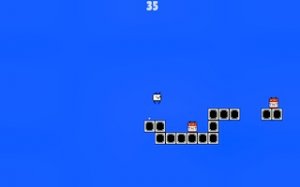
WASDbox Cooperative Puzzle Adventure splits control between two players. One moves a small pixel creature; the other commands a bat that flies and pushes blue boxes. The creature must reach a gem at the end of each level, but it cannot get there alone. The bat cannot collect items, so the creature depends on its partner to clear paths, bridge gaps, and block hazards. This forced division of labor is the game's central design choice, and it makes every level a conversation.
Across more than a dozen stages, the game introduces spikes, hostile creatures, spectral enemies, and locked gems that require keys. Each new element changes how the two players coordinate. Spikes demand precise box placement to create safe crossings. Keys add a collection step before the gem becomes available. Because the bat handles boxes and the creature handles items, neither player can ignore the other. The difficulty curve comes from combining these elements rather than from raw speed.
The creature typically moves with the keyboard's WASD keys, while the bat uses the arrow keys. This split control scheme keeps both players active at all times. The bat can push boxes to lift the creature onto higher platforms or to block hazards. The creature must gather all coins and the final gem to finish a level. Falling off blocks, touching spikes, or colliding with enemies ends the attempt, so observation and timing matter as much as planning.
Each level records completion time. That single feature shifts the game from a one-time puzzle to a repeatable challenge. After solving a level, pairs can replay it to shave seconds off their best run. The time tracker also gives friends a shared metric to compare, which suits the game's cooperative-but-competitive spirit. It is a light addition, but it extends the life of a dozen levels considerably.
The visual style is warm pixel art with clear, readable sprites. That clarity matters in a puzzle game where players must quickly identify boxes, hazards, and collectibles. The family-friendly presentation lowers the barrier for younger players or newcomers to logic games, while the later levels still demand creative thinking. The game is designed as an exclusive cooperative experience, so a second player is not optional—it is the point.
Sign in to comment
You must be logged in before posting a review or rating.
No comments yet. Be the first to comment!



Editorial Notes