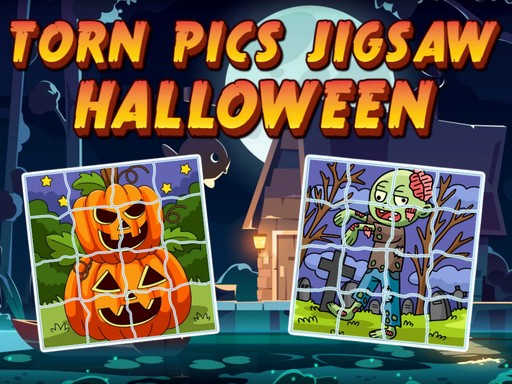
Halloween Jigsaw Puzzle Challenge sticks to a proven formula: assemble jigsaw pieces against a clock. Its strengths are accessibility and structure—simple drag-and-drop controls, a reference image for guidance, and two modes with 36 levels each. The gradual difficulty curve gives players room to improve. The main limitation is that the core loop does not change much beyond increasing complexity, so players seeking mechanical variety may find it repetitive.
Each level presents a grid of jigsaw pieces, every piece showing a fragment of a larger Halloween-themed image. The goal is straightforward: drag each piece to its correct position and release it to lock it in. A reference image sits alongside the puzzle, giving you a visual target to work toward. The challenge comes from the clock—every level has a time limit, so observation speed and decision-making matter as much as accuracy. [IMG_1]
The game splits its content into two distinct modes, and each mode contains 36 levels. Difficulty rises gradually across those levels, meaning early puzzles are forgiving while later ones demand sharper attention and faster pattern recognition. Completing all levels in both modes is the long-term goal. The structure gives players a clear sense of progression without overwhelming them at the start. [IMG_2]
Controls are built around a simple click-drag-release loop: select a piece, move it to the target spot, and let go. This works with a mouse or touch input, making the game accessible on different devices. If a puzzle stalls, hints are available to nudge you forward. The reference image also acts as a constant guide, so you are never completely in the dark about where a piece belongs. [IMG_3]
Because each level is timed, how you start matters. Building the frame first—edges and corners—gives you a stable structure to work within. From there, matching distinct colors or shapes in the Halloween artwork speeds up placement. Hints help when you are stuck, but leaning on them too often eats into the time you have left. Staying calm under pressure tends to produce fewer misplacements than rushing.
Sign in to comment
You must be logged in before posting a review or rating.
No comments yet. Be the first to comment!


Editorial Notes