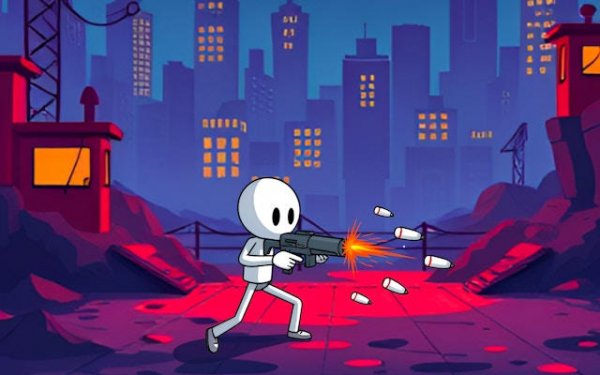
Ricochet Puzzle delivers a specific kind of satisfaction: lining up a multi-bounce shot that clears a stage in one attempt. The minimalist stickman visuals keep attention on angles and surfaces rather than spectacle. Its main limitation is pacing—players seeking fast action may find the deliberate, trial-and-error approach slow. Those who enjoy untimed logic puzzles with a physical twist will get the most from it.
Ricochet Puzzle centers on a single, repeatable action: aiming a projectile from your stickman character and releasing it so it caroms off walls, blocks, and other surfaces. The projectile can ricochet multiple times in one shot, which means a well-planned trajectory can reach enemies tucked behind cover or positioned around corners. The game does not rely on reflexes; it asks you to read the arena layout and predict how a shot will deflect before you commit to firing.
Every stage presents a fixed arrangement of surfaces and stickman targets. Because the projectile follows a physical bounce path, the order in which it strikes objects matters. A shot that seems blocked at first glance may open up after one or two rebounds. Players who study the geometry of each arena tend to find cleaner solutions than those who fire quickly. The minimalist stickman art keeps visual noise low, so the relevant surfaces and enemy positions stay easy to identify.
As you advance, obstacle layouts and enemy placements grow more complex. Early stages usually offer a direct or single-bounce solution, while later ones require multi-bounce routes that thread between blocks. The difficulty curve is gradual, giving you time to internalize how the projectile behaves after hitting different materials. Each level is self-contained, so a failed attempt costs only the time it takes to re-aim and try again.
Ricochet Puzzle sits between casual action and logic puzzle. It rewards patience over speed and creative thinking over memorization. If you enjoy games where a single clever shot resolves a seemingly impossible setup, the ricochet mechanic provides that payoff. If you prefer fast-paced combat, the deliberate pacing may feel slow. The game is best approached as a series of small, solvable geometry problems.
Sign in to comment
You must be logged in before posting a review or rating.
No comments yet. Be the first to comment!









Editorial Notes