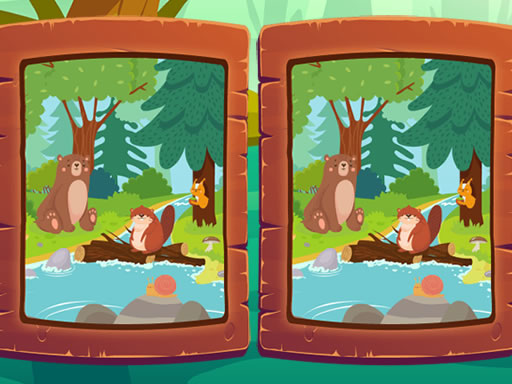
Animal Spot the Difference Puzzle focuses on careful looking rather than speed. The two-image comparison, tap-to-mark system, and penalty for incorrect taps create a light but meaningful challenge. Multiple levels with different animal scenes prevent the task from becoming stale. It is best suited to players who enjoy patient, low-pressure puzzles, including families and children. The main limitation is that the difficulty remains gentle throughout, which may not satisfy players seeking a more demanding observation test.
Animal Spot the Difference Puzzle presents two side-by-side pictures filled with animal scenes. Your task is to find every difference between them. The differences are deliberately small, often involving shifts in color, shape, or the presence of a small object. Because there is no timer, you can study each image for as long as you like. The game rewards patience over speed.
When you spot a difference, you tap that area on the screen. A circle appears to confirm the find and help you track progress. Random tapping is discouraged: a certain number of incorrect taps can end the round. This rule pushes you to be deliberate. Instead of swiping everywhere, you learn to scan systematically—top to bottom or left to right—to avoid missing details and to keep your mistakes low.
The game includes multiple levels, each with a new animal theme and a fresh set of differences. Changing the scene keeps the observation task from feeling repetitive. One level might focus on a group of animals in a forest, while another shows a different setting. The variety means you cannot rely on the same pattern of differences; you must re-examine each new pair of images from scratch.
Animal Spot the Difference Puzzle is built for a wide audience, including children and adults. The gentle challenge and lack of time pressure make it accessible to players who prefer a calm activity. It can be played alone or with family. The simple tap mechanic works on various devices, so no complex controls stand in the way of the core task: looking closely and finding what changed.
Sign in to comment
You must be logged in before posting a review or rating.
No comments yet. Be the first to comment!






Editorial Notes