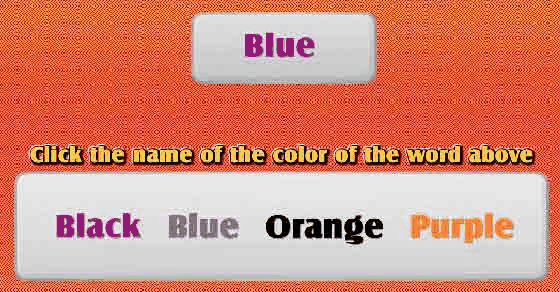
Word Color Match Challenge takes one well-known psychological phenomenon and builds a clean, quick game around it. The strength is its clarity: the rule is simple, feedback is immediate, and difficulty scales by shrinking response time. It suits players who want a short attention workout or a demonstration of cognitive conflict. The limitation is that it offers one core task, so variety comes from speed and session format rather than new mechanics.
Every trial in Word Color Match Challenge presents a single word that names a color, rendered in a contrasting ink. The player's job is to select the button that corresponds to the word's meaning, not the color of the text. This deliberate mismatch creates a cognitive conflict known as the Stroop effect: the brain automatically reads the word, and the player must override that automatic response to process the visual information correctly. Each correct selection advances to the next trial. Mistakes either end the session or reduce the score, depending on which mode is active.
The game does not stay at one pace. As correct answers accumulate, the interval between trials shortens. Early rounds give enough time to read the word, notice the ink color, and choose deliberately. Later stages compress that window until responses must be nearly instantaneous. This ramp-up is designed so that first-time players can learn the rules without frustration, while returning players face a genuine test of mental stamina. The curve aims to keep sessions engaging without becoming overwhelming.
The visual design uses clean, high-contrast colors to reduce confusion between the word and its ink. Each color option is clearly labeled and positioned for quick access. After every selection, immediate visual feedback confirms whether the choice was correct or incorrect, which helps players learn from mistakes in real time. The overall aesthetic is minimal and distraction-free, keeping attention on the cognitive task rather than on decorative elements.
Players can choose from different session structures, such as a set number of trials or a timed run. The scoring system rewards both speed and accuracy, with bonuses for consecutive correct answers. A running tally tracks performance across multiple sessions, giving a clear metric for improvement. No account or login is required, so the game works well for a quick mental warm-up or a longer training block. Each session offers a fresh sequence of color-word pairs.
Word Color Match Challenge runs in desktop browsers, on tablets, and on smartphones. Controls are optimized for both mouse and touch input, so the experience stays consistent across devices. The game loads quickly and needs no downloads or plugins. Because the rules can be explained in a single sentence, players of all ages can start immediately. There are no complex menus or settings to navigate, which lowers the barrier for casual users.
Regular play can help strengthen selective attention and inhibitory control, the ability to ignore irrelevant stimuli. These skills matter in everyday situations such as driving in heavy traffic or focusing in a noisy environment. The game also provides a practical demonstration of a well-known psychological phenomenon, making it useful for students or anyone curious about how the brain handles conflicting information. It is not a substitute for professional cognitive training, but it offers an accessible way to exercise these mental faculties in a low-pressure setting.
Sign in to comment
You must be logged in before posting a review or rating.
No comments yet. Be the first to comment!



Editorial Notes