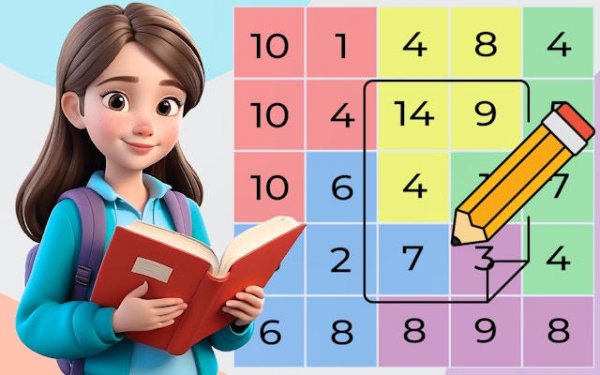
Sum Challenge: Number Grid Puzzle is a single-solution math puzzle that rewards methodical thinking over speed. Its strength is the layered constraint system: row, column, and colored-region targets overlap, so each selection must satisfy several conditions at once. The scalable grid sizes give beginners a gentle entry point while offering more demanding boards later. It suits players who enjoy arithmetic and logical elimination, though anyone hoping for fast, action-oriented play will find it deliberately slow.
Each puzzle hands you a grid of numbers plus target sums for every row, every column, and each colored region. Your job is to pick a set of numbers so that all those targets are met at once. Because a single number sits inside a row, a column, and a colored region simultaneously, every selection you make ripples across the board. The game is built around that overlap: you are not solving three separate puzzles, you are solving one puzzle where each choice has to satisfy several constraints.
The game states that each puzzle has exactly one correct solution. That single-solution design is what turns the grid into a logic exercise rather than a trial-and-error clicker. If a row has only two or three numbers, the possible combinations are limited, and you can often work out which ones must be selected before touching the rest of the board. From there, the process of elimination does the heavy lifting: a number that cannot fit any valid combination for its row, column, or region can be ruled out, and ruling things out narrows what remains.
Difficulty comes from grid size and the number of constraints rather than from new rules. Small grids, such as 3x3 layouts, keep the number of combinations manageable and let you learn how row, column, and region targets interact. Larger configurations multiply the interactions, so the same basic mechanic demands more planning and more systematic checking. The progression is designed so that players build skill over time instead of hitting a wall.
Sum Challenge is a low-pressure math game. There is no timer implied, no prior puzzle expertise required, and no penalty described for taking your time. That makes it reasonable for casual play, for practicing mental arithmetic, or for anyone who wants a short cognitive workout. Players who dislike guessing games will appreciate that the unique-solution rule means a correct answer can always be reasoned out rather than stumbled upon.
Sign in to comment
You must be logged in before posting a review or rating.
No comments yet. Be the first to comment!





Editorial Notes