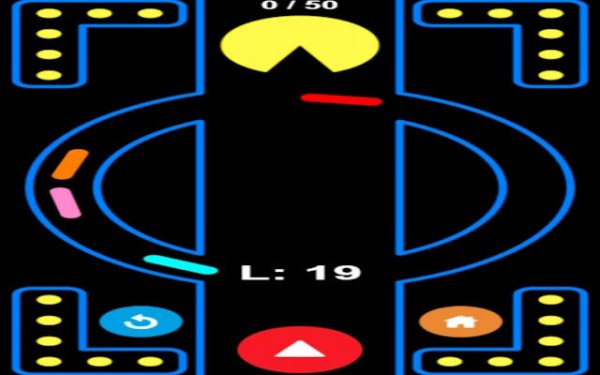
Pac Ball Launch Challenge strips the arcade formula down to charge, release, and read the rotation. That focus is its strength: there is nothing to learn except the timing window, and the restart-on-failure rule turns every mistake into useful information. The difficulty curve is real, and later stages demand sharper coordination. It suits players who enjoy precision challenges and do not mind repeating a level until the pattern clicks. The limitation is equally clear: anyone wanting variety, story, or multiplayer will find the scope narrow by design.
Pac Ball Launch Challenge is built around a single input: hold to charge, release to launch. On desktop you click and hold the mouse button; on mobile you touch and hold the screen. The longer you hold, the more force builds behind the ball. Releasing sends it toward Pac, and the outcome depends entirely on whether your release lines up with the rotating obstacle pattern in front of you. There is no aiming stick, no secondary button, and no way to steer mid-flight. That constraint is the game.
Every level places spinning obstacles between your ball and Pac. Contact with any of them ends the attempt and resets the level. Because the barriers rotate on fixed cycles, each stage becomes a pattern recognition problem before it becomes a timing problem. You watch a full rotation, identify the gap, and then decide how long to charge so the ball arrives at that gap rather than at a blade. Later stages rearrange the obstacles into tighter configurations, shrinking the window in which a safe release exists. [IMG_1]
The restart-on-failure rule is not a punishment; it is the teaching mechanism. Each failed launch gives you one more data point about how a specific barrier set moves, and the next attempt is informed by that. Players who treat restarts as free information tend to improve faster than players who rush. The cycle of charge, release, fail, and adjust is the entire skill curve, and it scales from a first-time player to someone chasing a clean run.
The premise is simple enough for a young child to understand, but the precision required at higher difficulty levels rewards adult reflexes and patience. Anyone who enjoys one-button timing challenges, pattern observation, or score-chasing will find the format familiar and the difficulty curve honest. The game runs in HTML5, so it loads in a browser on desktop or mobile without a download.
Sign in to comment
You must be logged in before posting a review or rating.
No comments yet. Be the first to comment!





Editorial Notes