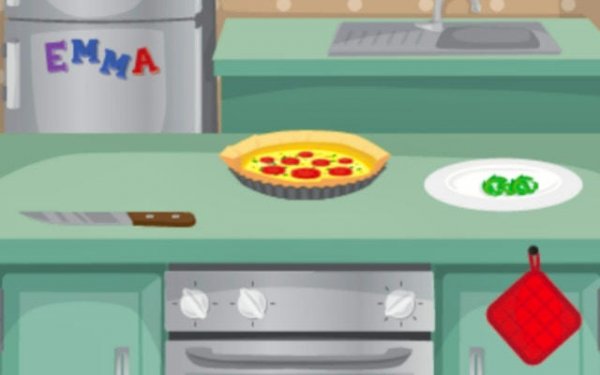
Savory Tart Kitchen Puzzle succeeds as a relaxed, family-friendly introduction to cooking. Its step-by-step recipe logic and spoken guidance from a virtual chef make it easy for beginners to follow, while the gentle reset system encourages careful attention without frustration. The game's main limitation is its narrow scope: it focuses on a single recipe, so players seeking variety may find it repetitive. Still, for families and cooking novices, it offers practical kitchen knowledge in an accessible format.
Savory Tart Kitchen Puzzle frames cooking as a sequence of logical decisions. Players choose ingredients, combine them in the right order, and finish each stage before the next begins. The challenge lies in remembering the proper sequence and avoiding mistakes. A correct action advances the recipe; an error triggers a gentle reset, which nudges players toward careful attention rather than punishment. This design keeps the focus on precision and memory rather than speed.
A virtual chef named Emma provides clear, spoken guidance throughout the process. She explains each ingredient and technique in plain language, making the game accessible even to players with no kitchen experience. Her encouraging tone supports learners as they work through the steps of making a tomato quiche. Because Emma narrates each action, the game doubles as a low-pressure introduction to basic cooking terminology and methods.
The game uses simple point-and-click or touch interactions. Players drag items to a mixing bowl, tap to stir, and click to select the correct ingredient. The interface is designed for young children and adults alike, with large buttons and clear visual cues. Immediate feedback on each action reinforces learning and helps players connect their choices to the recipe's progress.
Beyond entertainment, the game teaches practical kitchen skills. Players learn about ingredient preparation, mixing techniques, and baking times. The tomato quiche recipe is presented in a realistic manner, so the knowledge gained can be applied in a real kitchen. This educational aspect makes the game valuable for families and beginners who want a structured, hands-on introduction to cooking.
With no time pressure or complex mechanics, the game is designed to be relaxing and inclusive. Younger players can enjoy the colorful visuals and simple tasks, while older players appreciate the structured learning. The game rewards patience and precision rather than speed, making it a calm activity for anyone interested in cooking. After completing the quiche, players can revisit the recipe at any time using an in-game reference card, allowing them to practice specific steps or improve their accuracy. Multiple playthroughs reinforce the learning through repetition.
Sign in to comment
You must be logged in before posting a review or rating.
No comments yet. Be the first to comment!







Editorial Notes