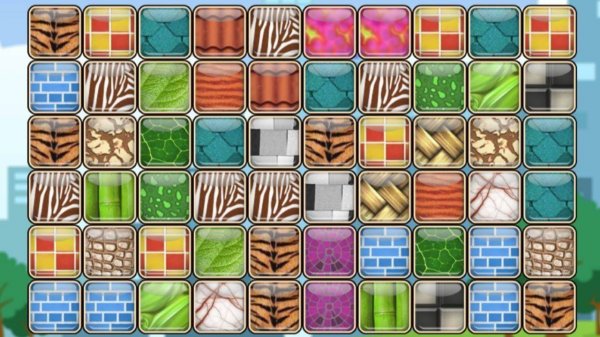
Tile Connect Pattern Match keeps its rules minimal: pair identical patterns with a path that avoids other tiles. The real depth comes from ordering your clears, since a careless link can block a needed route. No time limits, clear tile designs, and a gradual difficulty curve make it approachable for children and still engaging for adults who enjoy methodical planning. The main limitation visible in the description is that it offers no stated competitive or timed mode, so players seeking speed pressure may find it too relaxed.
Every puzzle in Tile Connect Pattern Match revolves around one task: find two tiles that display the same pattern, then connect them with a path that does not cross other tiles or obstacles. Tiles show distinct designs, so recognition depends on visual comparison rather than memory. When a valid connection is made, both tiles clear from the board. Each cleared pair exposes more of the underlying layout, gradually emptying the board. The rule set is small enough for a first-time player to grasp immediately, yet the path restriction adds a spatial reasoning layer that keeps later boards from feeling automatic.
Because a connection cannot pass through other tiles, the order in which you clear pairs matters. A careless link can block a route that another pair needs, turning a solvable board into a stalled one. Effective play means scanning the whole layout before committing, identifying which matching pairs are most accessible, and thinking a few moves ahead about how each removal changes the available paths. Patience and observation outperform speed here, since the game rewards methodical problem-solving rather than quick reactions.
There are no time limits, so every board can be studied at a comfortable pace. Early puzzles introduce the matching mechanic with simple arrangements, then later stages present more complex configurations that demand closer inspection and better planning. New tile patterns appear as you advance. Difficulty rises gradually, letting you build confidence before facing denser layouts. The absence of a clock removes the frustration common in timed matching games and supports steady improvement.
The presentation favors a clean, colorful look. Patterns are designed to be easy to distinguish, which reduces eye strain during longer sessions, and the background stays calm and unobtrusive so attention remains on the tiles. The content contains no violent or inappropriate themes, and the controls are simple enough for young players to use without instruction. That accessibility, combined with the strategic depth of path planning, lets the game work as a shared family activity or a quiet solo pastime.
Sign in to comment
You must be logged in before posting a review or rating.
No comments yet. Be the first to comment!







Editorial Notes