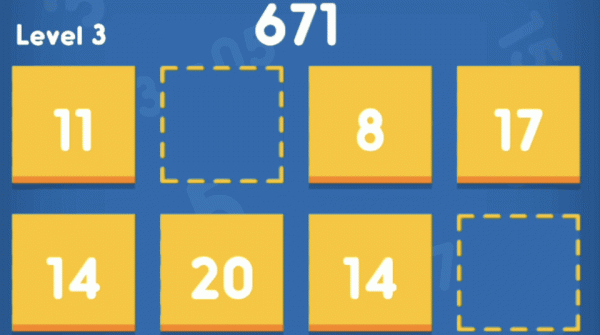
Tile Division Number Puzzle delivers a focused, distraction-free experience built around a single clever mechanic: merging adjacent tiles by division. The option to choose between 3x3 and 4x4 grids gives flexibility for different session lengths, while the absence of timers or penalties makes it accessible to a wide age range. The random tile placement adds replay value, though players seeking fast-paced action may find it too slow. Its educational angle is a natural byproduct of the core loop rather than a forced feature.
Tile Division Number Puzzle places a grid of numbered tiles in front of you. Your task is to select two adjacent tiles and combine them using division. For example, a tile showing 8 next to a tile showing 4 can be merged to produce a 2. The original tiles disappear, and a new tile takes their place. This frees up space on the board, which is essential because the grid can fill up if you make poor choices. Each successful division adds points to your score, and larger dividends yield higher rewards. The core challenge is planning several moves ahead so you always have a valid division available.
You can start with either a 3x3 or a 4x4 grid. The smaller board suits short breaks or players new to the concept. The larger grid provides more room for complex sequences and longer play. Both sizes rely on the same strategy: scan for pairs of tiles where one number divides evenly into the other. No timers or penalties pressure you, so you can consider each move carefully. This makes the game flexible for quick mental breaks or extended puzzle sessions.
The interface uses a simple, uncluttered layout. Tiles are clearly numbered and color-coded, making them easy to distinguish at a glance. Dragging a tile to an adjacent tile produces a smooth animation, giving clear feedback for each action. There are no pop-ups, ads, or distractions during play. The design focuses entirely on the puzzle, which helps maintain concentration. The overall aesthetic is calm and neutral, appealing to a wide age range.
Regular play encourages faster recognition of division relationships and improves mental arithmetic. The scoring system rewards efficient use of the board, pushing you to clear as many tiles as possible before running out of moves. Since tile numbers appear randomly, each session presents a unique arrangement. This randomness ensures that no two games feel exactly the same. The lack of timers or penalties allows you to experiment with different strategies, learning from each attempt without frustration.
Sign in to comment
You must be logged in before posting a review or rating.
No comments yet. Be the first to comment!



Editorial Notes